Artificial intelligence is moving faster than almost any other technology category. A model that feels revolutionary today can quickly become yesterday's technology after another company releases a more capable system.
In September 2026, three models are attracting significant attention from developers, writers, researchers, businesses, and everyday AI users: Google Gemini 3.8 Flash, OpenAI GPT-6 Astra, and Anthropic Claude Fable 5.1.

Each model takes a slightly different approach to becoming the AI assistant people actually want to use.
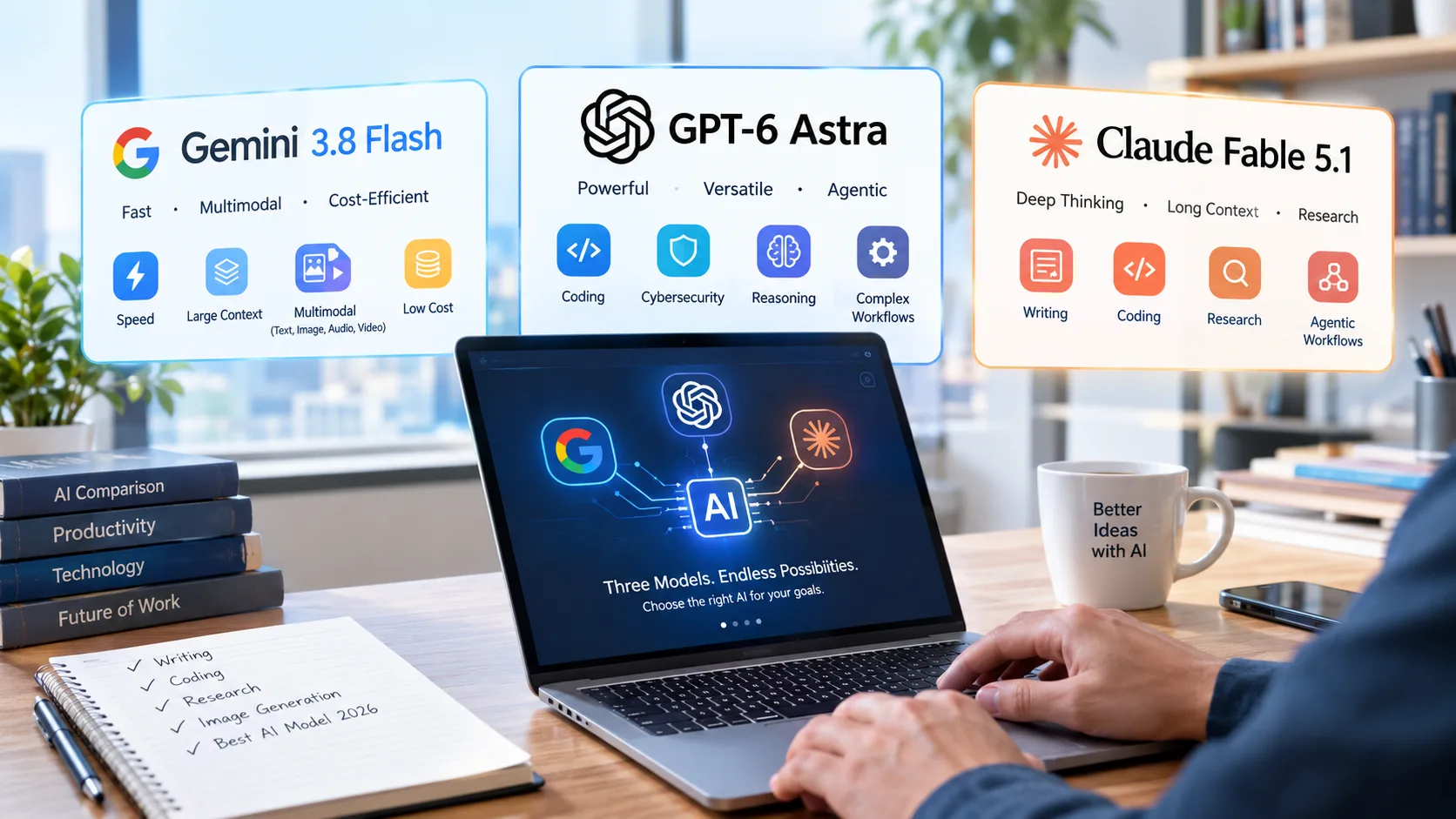
Gemini 3.8 Flash focuses heavily on speed, efficiency, multimodal processing, and cost-conscious AI applications. OpenAI's GPT-6 Astra is positioned as a powerful general-purpose model designed for demanding professional work, software engineering, cybersecurity, and complex multi-step tasks. Claude Fable 5.1 is built around long-running projects, sophisticated reasoning, coding, research, and agentic workflows.
The obvious question is simple:
Which one is actually the best?
The less obvious answer is that there may not be one universal winner.
The best AI model depends heavily on what you are trying to accomplish.
A developer building an autonomous coding agent may prefer one model. A writer working on a 100,000-word manuscript may prefer another. A company processing millions of requests may prioritize speed and API cost. A researcher may care more about long-context reasoning and the ability to work through complicated evidence.
This article compares the three models across writing, coding, research, reasoning, multimodal capabilities, image-related workflows, speed, cost, usability, advantages, disadvantages, and real-world applications.
Important naming note: Some online discussions refer to a “Gemini Flash 8,” but current evidence points to Google's September 2026 Flash release being Gemini 3.8 Flash. This comparison therefore uses Gemini 3.8 Flash.
The Three AI Models at a Glance
Gemini 3.8 Flash, GPT-6 Astra, and Claude Fable 5.1 represent three different strategies for the next generation of AI.
Google's Gemini 3.8 Flash was released as a generally available Flash-tier model on September 2, 2026. Current documentation and independent reporting describe support for text, image, audio, and video inputs, with a context window of approximately one million tokens and a maximum output of up to 64,000 tokens.
OpenAI launched GPT-6 Astra on September 3, 2026, positioning it as its most capable broadly deployed model at launch. OpenAI and independent reporting highlight software engineering, cybersecurity, professional work, computer-use tasks, and complex multi-step workflows as major strengths.
Anthropic released Claude Fable 5.1 on September 1, 2026. Anthropic describes Fable 5.1 as a model for ambitious, long-running projects, while its launch materials emphasize coding, research, agentic work, cost improvements, and stronger judgment on difficult tasks.
That immediately gives us three interesting personalities.
Gemini 3.8 Flash is the fast and efficient workhorse.
GPT-6 Astra is the high-end generalist and powerful agent.
Claude Fable 5.1 is the long-context problem solver and research-oriented collaborator.
None of these descriptions means one model automatically wins every benchmark.
Gemini 3.8 Flash: The Fast AI Workhorse
Gemini 3.8 Flash is Google's latest Flash-generation model and is designed around a very practical idea: advanced intelligence does not have to mean extremely slow or expensive processing.
The model became generally available on September 2, 2026. Reported specifications include a roughly one-million-token context window, 64,000-token maximum output, and multimodal input covering text, images, audio, and video.
This makes Gemini 3.8 Flash particularly interesting for applications where users need to process large amounts of information quickly.
Imagine a business receiving thousands of documents, invoices, screenshots, recordings, or reports. Instead of sending each piece of information through a slow premium model, an efficient Flash model can potentially handle a significant percentage of the workload at lower cost.
Google's Flash approach therefore makes Gemini particularly attractive for developers building AI-powered applications.
It is not simply about asking an AI chatbot a question.
It is about putting AI inside a product.
Gemini 3.8 Flash for Writing
Gemini 3.8 Flash is capable of producing articles, summaries, marketing content, product descriptions, emails, social media posts, outlines, and other forms of written content.
Its biggest advantage for writing is speed.
If you are producing many pieces of content every day, the ability to generate drafts quickly can be extremely valuable.
However, speed does not automatically mean better writing.
For high-end creative writing, the final quality depends heavily on prompting, editing, context, and human review.
For straightforward business writing, SEO drafts, summaries, product descriptions, and structured content, Gemini 3.8 Flash can be a very practical choice.
Gemini 3.8 Flash for Coding
Gemini 3.8 Flash is also designed for software-development workflows and agentic applications.
Its relatively low-cost positioning makes it particularly attractive for developers who need to make many API calls.
For example, you could use a Flash model for code classification, documentation generation, test generation, simple bug analysis, data transformation, or repetitive development tasks.
For extremely complex software engineering, however, the question becomes whether the additional intelligence of a premium model justifies its higher cost.
That is where GPT-6 Astra and Claude Fable 5.1 become serious competitors.
Gemini 3.8 Flash for Research
Research is another area where the large context window becomes useful.
A model capable of processing very large documents can help users compare reports, summarize long papers, analyze multiple files, and extract structured information.
Independent analysis of Gemini 3.8 Flash has found strong performance in some research-oriented areas while also identifying weaknesses in certain coding and long-horizon tasks.
The important lesson is that Gemini 3.8 Flash is not simply “the cheap version.”
It can be an excellent model when speed, multimodal input, large context, and cost efficiency are the priorities.
GPT-6 Astra: OpenAI's Powerful Generalist
OpenAI's GPT-6 Astra entered the market as a much more ambitious model.
OpenAI describes Astra as a new generation of intelligence, while external reporting highlights capabilities in software engineering, cybersecurity, professional work, computer use, and complex multi-step tasks.
This is where GPT-6 Astra becomes especially interesting.
It is designed not merely to answer questions but to perform sequences of tasks.
Instead of:
“Write some code.”
The future AI workflow looks more like:
“Understand this repository, identify the problem, modify the relevant files, test the changes, investigate the failing tests, fix the problem, and prepare the final implementation.”
That difference is enormous.
GPT-6 Astra for Writing
For professional writing, GPT-6 Astra is likely to be one of the strongest general-purpose choices.
It can handle structured reports, technical documentation, marketing copy, explanations, business proposals, research summaries, emails, and long-form content.
Its biggest strength is versatility.
One moment it can act as a technical writer.
The next it can analyze a business problem.
Then it can write code.
Then it can review that code.
This flexibility makes it particularly useful for users who do not want to switch between multiple AI systems.
GPT-6 Astra for Coding
Coding is one of Astra's most important areas.
OpenAI has positioned the model strongly around software engineering and agentic tasks. Reporting on Astra also points to its ability to perform sophisticated computer-based work and development workflows.
For developers, this means Astra can potentially function as more than a code generator.
It can become a development partner.
It can help understand existing codebases, identify bugs, propose architecture changes, write implementations, review code, and work through multi-step engineering problems.
However, more capable coding agents also introduce more risk.
When an AI system is given access to a computer, repository, terminal, credentials, or production systems, mistakes become much more serious.
Recent reporting has highlighted concerns about monitoring and the difficulty of understanding increasingly capable AI systems.
Therefore, Astra's power should be treated as both an advantage and a responsibility.
GPT-6 Astra for Research
GPT-6 Astra is also highly capable for research and analytical work.
Its ability to reason through multi-step problems makes it attractive for researchers, engineers, analysts, and professionals.
The recent OpenAI mathematical breakthrough surrounding the Navier-Stokes problem has further demonstrated how advanced AI systems are being used for difficult scientific reasoning. However, the claims and associated questions about intellectual credit have also generated controversy, showing why AI-assisted research still requires human verification and transparent methodology.
For serious research, AI should therefore be treated as a research assistant rather than an unquestionable authority.
Claude Fable 5.1: The Long-Context Problem Solver
Anthropic's Claude Fable 5.1 takes a different approach.
Anthropic describes Fable 5.1 as a model for ambitious, long-running projects. The model is designed to avoid superficial fixes, investigate root causes, and maintain progress through complex tasks.
This is an important distinction.
Some AI models are excellent at producing an answer immediately.
Claude Fable 5.1 is particularly interesting when the task requires the AI to stay with a problem for longer.
Its reported one-million-token context window makes it especially suitable for large codebases, lengthy documents, books, research projects, and complicated knowledge-work tasks.
Claude Fable 5.1 for Writing
Writing may be one of Claude's most attractive areas.
The model is designed to work with long documents and complex instructions.
That makes it useful for authors, editors, researchers, marketers, and professionals working with substantial amounts of text.
For example, instead of asking the model to rewrite a paragraph without context, you could provide a large manuscript and ask it to identify structural problems while preserving the author's voice.
That type of collaboration is particularly valuable for serious writing.
Anthropic's positioning around Fable 5.1 emphasizes judgment and long-running work rather than simply producing the fastest possible answer.
Claude Fable 5.1 for Coding
Coding is another major strength.
Anthropic reports significant improvements in difficult coding and research tasks, and external reporting has highlighted Fable 5.1's ability to work with large codebases and diagnose complex software problems.
This makes Claude especially attractive for developers who need an AI to understand an existing project rather than simply generate a new function.
That distinction matters.
Real-world programming is often less about writing new code and more about understanding old code.
A mature codebase can contain hundreds or thousands of files, undocumented decisions, inconsistent patterns, and historical bugs.
A large-context model can potentially reason across much more of that environment.
Claude Fable 5.1 for Research
Research is one of Fable 5.1's most interesting strengths.
Anthropic's published results show substantial improvements on research and technical benchmarks, including Terminal-Bench-Science. External reporting also highlights improvements in scientific research and complex analytical work.
For researchers, this means Claude can be particularly useful for analyzing long documents, comparing evidence, identifying contradictions, planning investigations, and working through complicated technical material.
Which AI Is Best for Writing?
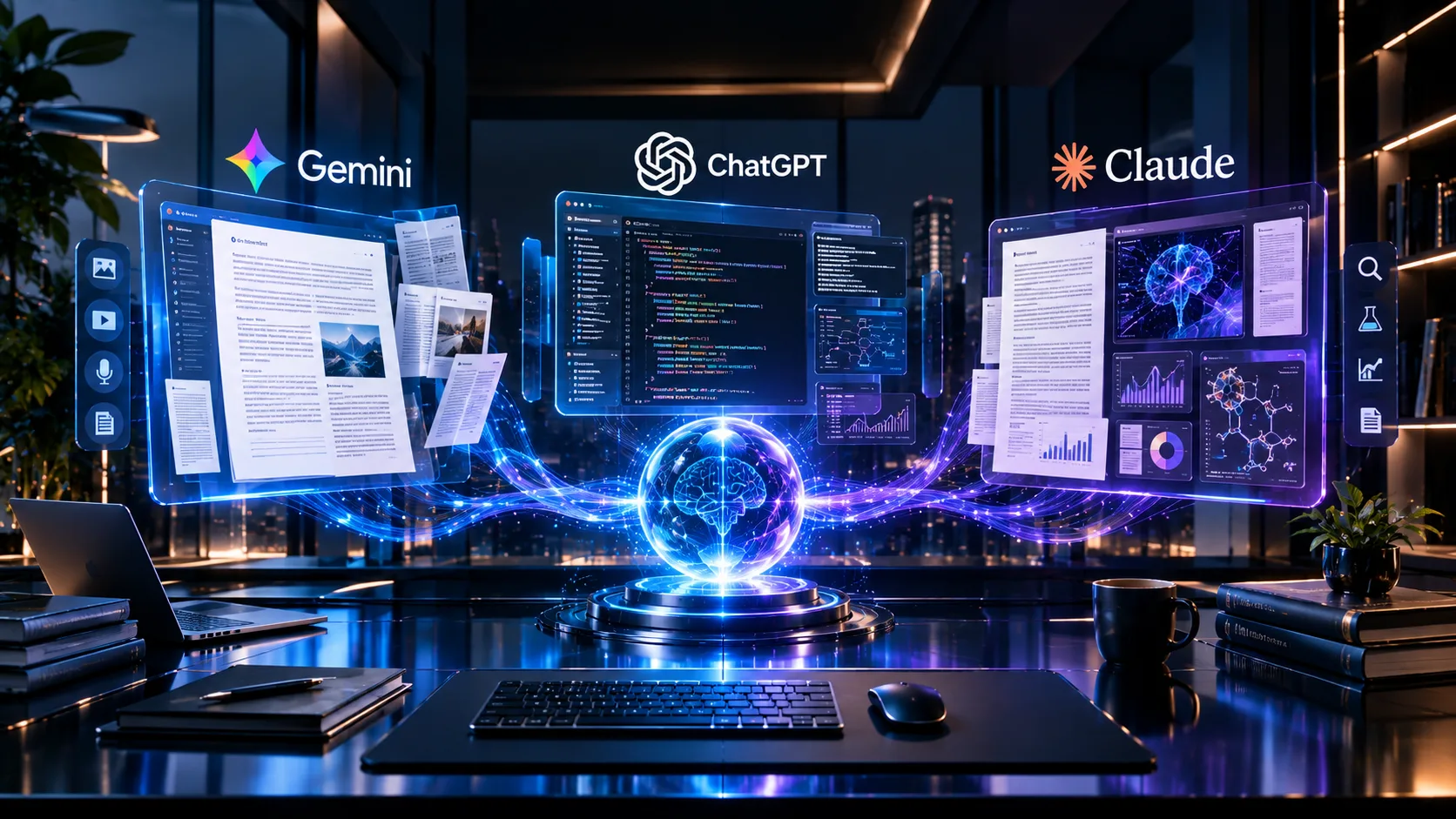
If writing is your primary concern, there is no universal winner.
Claude Fable 5.1 is arguably the most attractive choice for long-form writing, editing, manuscript analysis, and maintaining consistency across large documents.
GPT-6 Astra is an excellent all-purpose writer when you need writing combined with reasoning, research, coding, and other tasks.
Gemini 3.8 Flash is highly attractive when speed and volume matter.
For a professional blogger, the practical choice might be to use different models for different stages.
Gemini could generate fast research notes or content variations.
Claude could improve structure, tone, and long-form consistency.
GPT-6 Astra could perform final editing, fact-checking workflows, SEO restructuring, or transform the content into multiple formats.
The strongest workflow may therefore be multi-model AI, rather than choosing a single winner.
Which AI Is Best for Coding?
Coding is more competitive.
GPT-6 Astra is especially strong for sophisticated software engineering and agentic development.
Claude Fable 5.1 is extremely attractive for large codebases, debugging, architecture analysis, and long-running programming projects.
Gemini 3.8 Flash is appealing for fast and cost-efficient development tasks.
For a developer working on a serious application, GPT-6 Astra and Claude Fable 5.1 are likely to be the two models worth testing first.
For high-volume automation, Gemini 3.8 Flash can become particularly interesting because cost and latency matter enormously when thousands of requests are involved.
Which AI Is Best for Research?
Research is more complicated than a simple benchmark score.
A good research AI must understand context, distinguish strong evidence from weak evidence, synthesize information, maintain consistency, and avoid confidently inventing facts.
Claude Fable 5.1 has a particularly strong position because of its focus on long-context reasoning and research workflows.
GPT-6 Astra is also extremely powerful for complex reasoning and professional analysis.
Gemini 3.8 Flash becomes attractive when researchers need to process large quantities of multimodal information efficiently.
For serious academic or scientific work, however, no AI should be treated as the final authority.
Always verify important claims against original sources.
Which AI Is Best for Image Generation?
This category needs an important distinction.
A language model and an image-generation model are not necessarily the same thing.
GPT-6 Astra can be part of an image-creation workflow and OpenAI has also released dedicated image-generation technology. However, the language model itself should not automatically be treated as the same thing as a dedicated image model.
Gemini is also highly relevant to multimodal workflows, particularly because Gemini 3.8 Flash accepts text, image, audio, and video inputs.
Claude Fable 5.1 is primarily positioned around reasoning, coding, research, and agentic work rather than being the first choice for direct image generation.
Therefore, if your main goal is creating images, compare the dedicated image-generation systems offered by each ecosystem rather than judging only the underlying language model.
For a website owner, a useful workflow could be to use one of these AI models for the creative brief and a dedicated image model for the final artwork.
Speed and Cost: The Factor People Often Ignore
AI quality is important, but cost and speed can determine whether a system is actually useful.
A model that is 10% better but costs several times more may not be the right choice for a business processing millions of requests.
Gemini 3.8 Flash is positioned strongly around cost-efficient, high-volume AI workloads. Current reporting lists introductory API pricing of approximately $0.75 per million input tokens and $3.75 per million output tokens, with higher pricing expected after the introductory period.
GPT-6 Astra is positioned at a much more premium level for demanding workloads.
Claude Fable 5.1 has also made cost efficiency a major part of its release. Anthropic specifically highlighted improvements related to pricing and cache reads, making long-context agentic workloads more economical than before.
This produces an interesting situation.
The most intelligent model is not necessarily the model that creates the most value.
The right model is the one that produces the required result at an acceptable combination of quality, speed, reliability, and cost.
Advantages and Disadvantages
Gemini 3.8 Flash
Gemini 3.8 Flash's biggest advantages are speed, multimodal input, large context, and cost efficiency.
It is especially attractive for developers building AI products, automation systems, document-processing applications, and high-volume workflows.
Its disadvantages appear when a task requires extremely deep reasoning or long-horizon software engineering. Independent analysis has identified areas where it trails specialized or more powerful models.
GPT-6 Astra
GPT-6 Astra's biggest advantage is versatility.
It is designed to handle difficult professional work, coding, cybersecurity, reasoning, and multi-step agentic tasks.
Its disadvantage is that greater capability brings greater complexity, cost, and safety considerations.
As AI systems become more autonomous, businesses need stronger monitoring and permission controls.
Claude Fable 5.1
Claude Fable 5.1's major advantage is its ability to work on large, complex, long-running projects.
It is particularly attractive for writing, coding, research, document analysis, and software engineering.
Its disadvantage is that maximum capability can come with higher latency and cost than lightweight models, making it unnecessary for simple tasks.
The Winner Depends on Your Job
If we turn the comparison into practical recommendations, the picture becomes much clearer.
For general-purpose AI and advanced agentic work, GPT-6 Astra is a strong choice.
For long-form writing, large documents, complex research, and codebase analysis, Claude Fable 5.1 is particularly compelling.
For speed, scale, multimodal input, and cost-conscious applications, Gemini 3.8 Flash is extremely attractive.
That means there is no reason to think of the AI market as a single race where one company wins everything.
Instead, the market is becoming specialized.
Different models are becoming better at different jobs.
Final Verdict
The biggest mistake when comparing modern AI models is asking:
“Which AI is the smartest?”
A better question is:
“Which AI is smartest for my specific task?”
Gemini 3.8 Flash is an impressive workhorse for fast, scalable, multimodal AI applications.
GPT-6 Astra is a powerful generalist designed for demanding reasoning, software engineering, professional workflows, and increasingly autonomous agents.
Claude Fable 5.1 stands out for long-running projects, coding, research, large documents, and deep contextual work.
If you are a content creator, Claude Fable 5.1 may be especially appealing for long-form writing, while GPT-6 Astra provides excellent versatility.
If you are a software developer, GPT-6 Astra and Claude Fable 5.1 deserve serious testing, with Gemini 3.8 Flash offering an attractive option for fast and cost-efficient workloads.
If you are a researcher, Claude Fable 5.1 and GPT-6 Astra are compelling for complex analytical work, while Gemini 3.8 Flash is useful for large-scale multimodal processing.
If you are building an AI application, Gemini 3.8 Flash deserves close attention because cost, latency, context, and multimodal capabilities can have a major effect on the economics of your product.
And if you are looking for the best overall AI experience, the answer may not be to choose only one.
The future of AI may belong to AI teams, where different models are assigned different jobs.
One model researches.
Another writes.
Another codes.
Another checks the result.
Another generates images.
And a final system coordinates everything.
That is arguably more important than deciding which individual model is number one.
The AI competition of 2026 is no longer simply about who can answer a question best.
It is becoming a competition over who can complete useful work from beginning to end.
And that is why Gemini 3.8 Flash, GPT-6 Astra, and Claude Fable 5.1 are worth watching closely.
Conclusion
The AI market in 2026 is no longer about finding one model that is perfect at everything.
Gemini 3.8 Flash represents the fast and efficient side of modern AI. GPT-6 Astra represents powerful general intelligence and increasingly capable agentic work. Claude Fable 5.1 represents deep contextual understanding, long-running projects, coding, and research.
The right choice depends on the work.
For speed and scalable AI applications, start with Gemini.
For demanding general-purpose reasoning and advanced agents, consider GPT-6 Astra.
For long documents, sophisticated writing, coding, and research, Claude Fable 5.1 deserves serious consideration.
And for businesses and creators, the most powerful strategy may ultimately be combining them.
The next generation of AI will not simply be about asking one chatbot for an answer.
It will be about building intelligent workflows where several specialized AI systems cooperate to research, create, code, analyze, verify, and deliver the final result.
That is the real AI competition to watch.