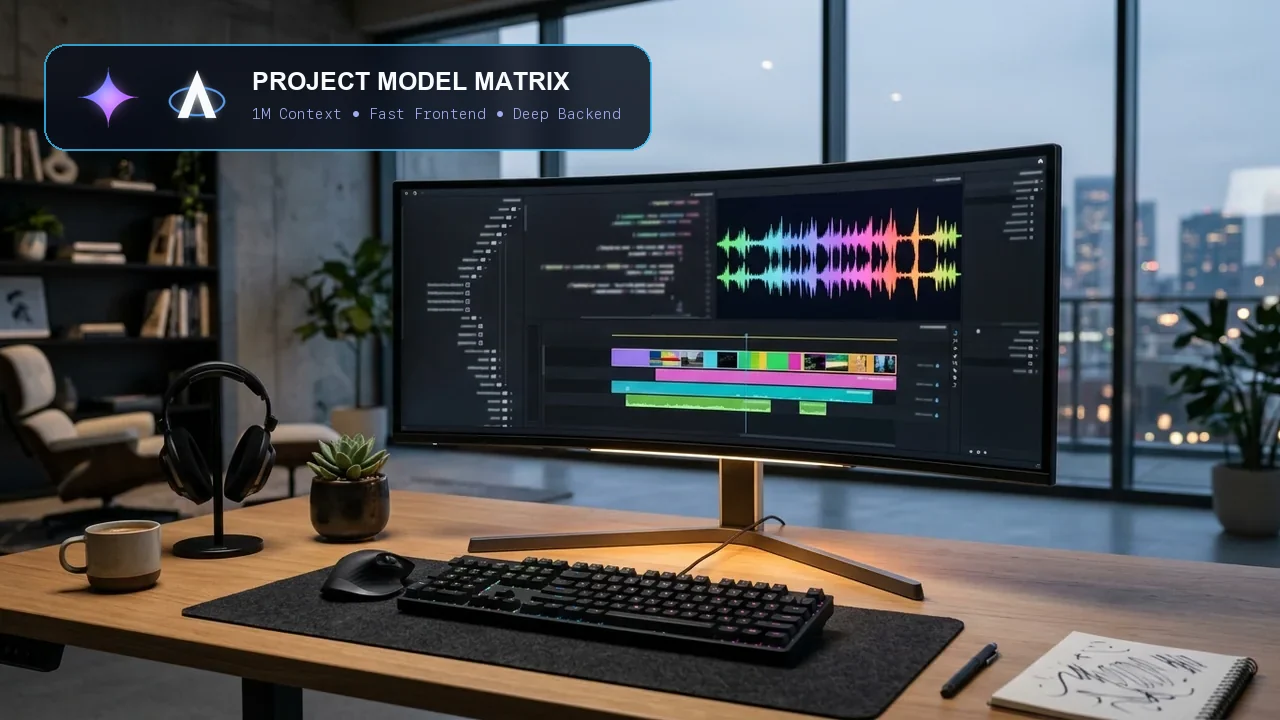
One of the most refreshing design choices inside Google Antigravity is that it refuses to lock developers into a single model hammer for every engineering nail. Open the model roster in Antigravity today and you are greeted by sixteen distinct configurations spanning six heavyweight model families: Gemini 4 Carbon, Gemini 4 Argon, Gemini 3.8 Flash, Claude Opus 5.5, Claude Sonnet 5.5, and GPT-OSS 120B.
Having sixteen model choices in one IDE and CLI is a superpower—right up until a deadline is looming and you are wondering whether a sticky React state bug belongs on Gemini 4 Carbon (High), Claude Opus 5.5 (High), or Gemini 4 Argon (Medium).
Because our engineering team builds full-stack Laravel, React/TypeScript, Python automation, and DevOps tooling inside Antigravity every day, we benchmarked the entire live roster across real repositories rather than synthetic multiple-choice quizzes. Below is our honest, field-tested guide to every AI model available in Google Antigravity—including their personalities, blind spots, and the exact model you should pick for each kind of project.
The Complete Google Antigravity Model Roster at a Glance
Before matching models to project types, let's look at all six model families available in Antigravity's native picker and /swarm orchestrator, along with their supported High, Medium, and Low reasoning tiers:
| Model Family in Antigravity | Available Effort Tiers | Standout Strength | Watch Out For |
|---|
| Gemini 4 Carbon | Low, Medium, High | Deepest root-cause debugging, 1M unified context, defensive security, long-horizon agent reliability | Slower time-to-first-token on High; overkill for simple UI copy or CSS tweaks |
| Gemini 4 Argon | Low, Medium, High | Fast, rock-solid all-rounder with 1M context and native multimodal (video/audio/PDF/image) ingestion | Slightly less tenacious than Carbon on deceptive concurrency or formal math proofs |
| Gemini 3.8 Flash | Low, Medium, High | Blistering speed, ultra-light quota footprint, high-volume repo scanning, log triage, and test execution | Can take shortcuts on sprawling 15-file architectural refactors |
| Claude Opus 5.5 | Low, Medium, High | Nuanced software architecture prose, surgical legacy-code refactoring, and strong editorial taste | Smaller context ceiling than Gemini 4's 1M pool; burns premium quota quickly on giant files |
| Claude Sonnet 5.5 | Low, Medium, High | Exceptional frontend UI/UX sensibility, clean TypeScript/React components, snappy agentic tool loops | Less suited to ingesting entire monorepos or raw video/audio bug captures in one shot |
| GPT-OSS 120B | Medium | Predictable, open-weight 120B baseline ideal for standardized script generation, SQL helpers, and second opinions | Lacks High deep-reasoning tier and native multimodal video/audio understanding |
Deep Dive: How Each Model Family Actually Feels in Real Codebases
1. Gemini 4 Carbon (Low / Medium / High) — The Principal Systems Debugger
When a bug has already defeated two human developers—say, an intermittent queue serialization failure, a subtle stale-cache race condition, or an authorization policy leak—Gemini 4 Carbon is the model you bring into the room. Because it combines DeepMind's deepest verification training with a full 1,048,576-token window, you can drop forty related backend files, migration histories, and raw error logs into context simultaneously. On Medium it feels like a methodical staff engineer; on High it behaves like an automated security and architecture review board.
Figure 2: Modern multi-model engineering inside Google Antigravity lets teams pair Google's 1M-context Gemini 4 models with Anthropic's Claude 5.5 family and open-weight models in a single workspace.
2. Gemini 4 Argon (Low / Medium / High) — The Ultimate Daily Driver
If we could only keep one default pinned for 80% of full-stack software engineering, Gemini 4 Argon (Medium) wins hands down. It reads screen-recorded bug videos, Figma export screenshots, PDF specifications, and large codebases effortlessly, then writes clean PHP, Python, Go, Rust, or TypeScript without ceremony. Better yet, because it shares the same quota pool efficiently, you can iterate rapidly all afternoon without watching a progress spinner.
3. Gemini 3.8 Flash (Low / Medium / High) — The High-Throughput Scout
Do not underestimate Gemini 3.8 Flash just because "Flash" is in the name. Running Gemini 3.8 Flash (Medium) or (High) as a read-only codebase scout, unit-test generator, localization translator, or CI log analyzer feels nearly instantaneous. In multi-agent Antigravity swarms, spawning three Flash helpers to audit 200 route definitions or verify broken links takes seconds and barely dents your quota.
4. Claude Opus 5.5 (Low / Medium / High) — The Careful Surgeon & Technical Writer
Anthropic's Claude Opus 5.5 shines brightest when nuance, code aesthetics, and human-readable prose matter equally. When disentangling a decade-old monolithic class where variable names lie about what functions actually do, or when drafting investor-ready architecture RFCs and developer documentation, Opus 5.5 writes with remarkable clarity and restraint—touching only the lines that need to change.
5. Claude Sonnet 5.5 (Low / Medium / High) — The Frontend & Product Specialist
Ask five full-stack engineers why they switch to Claude Sonnet 5.5 (Medium or High), and four of them will say two words: frontend taste. When designing responsive Tailwind v4 layouts, Framer Motion micro-interactions, accessible Radix/Headless UI components, or interactive dashboard charts, Sonnet 5.5 has an uncanny eye for spacing, visual hierarchy, and clean React hook composition.
6. GPT-OSS 120B (Medium) — The Independent Open-Weight Baseline
Available in a balanced Medium configuration—and often sitting on a separate quota bucket—GPT-OSS 120B is a pragmatic utility player. Teams use it for deterministic Python data-wrangling scripts, regex generation, standard CRUD boilerplate, cross-checking SQL queries, and testing how prompts behave on open-weight 120-billion-parameter class architectures before deploying self-hosted internal models.
Figure 3: Frontend UI polish, full-stack SaaS APIs, and mobile app debugging each reward different model strengths—from Sonnet 5.5's component taste to Carbon's deep concurrency verification.
Project-by-Project Matrix: Which Model Should You Pick?
Stop guessing at the start of a sprint. Match your exact project type below to the recommended primary model, secondary helper, and reasoning tier:
| Project Type / Engineering Scenario | Best Primary Model | Best Helper / Verifier Model | Why This Pairing Works |
|---|
| Full-Stack SaaS (Laravel + React / Next.js) | Gemini 4 Argon (Medium) | Claude Sonnet 5.5 (Medium) for UI polish | Argon handles backend schemas, routes, and large context fast; Sonnet nails pixel-clean UI components |
| Legacy Monolith Refactoring (500+ files) | Gemini 4 Carbon (High) | Gemini 3.8 Flash (Medium) for repo search | Only Gemini 4 holds massive cross-module dependency chains in its 1M window while verifying side effects |
| Design Systems, Landing Pages & Dashboards | Claude Sonnet 5.5 (High) | Gemini 4 Argon (Medium) for visual screenshot QA | Sonnet crafts refined typography and animations; Argon visually inspects rendered browser screenshots |
| Security Audits, Auth & Payment Pipelines | Gemini 4 Carbon (High) | Claude Opus 5.5 (High) as second-pair-of-eyes | Carbon leads on vulnerability detection & patch verification; independent cross-family review catches blind spots |
| Mobile Apps (Flutter, React Native, Swift, Kotlin) | Gemini 4 Argon (Medium) | Gemini 4 Carbon (Medium) for native bridge bugs | Argon iterates screens and state fast, plus reads recorded mobile screen-capture videos natively |
| Data Science, ETL & Python CLI Automation | Gemini 4 Argon (Medium) | GPT-OSS 120B (Medium) for script utilities | Fast iteration on pandas/Polars pipelines while preserving primary quota on utility scripts |
| Technical Docs, Blogs & Developer Guides | Claude Opus 5.5 (Medium) | Gemini 4 Argon (Low) for metadata & schemas | Opus delivers warm, natural editorial flow; Argon validates every code snippet and JSON-LD schema |
| CI/CD Triage, Bulk Linting & i18n Localization | Gemini 3.8 Flash (Low/Med) | Gemini 4 Argon (Low) | Sub-second throughput across hundreds of repetitive files at minimal cost |
Pro Tip: Quota-Smart Model Switching Mid-Project
Notice how Antigravity groups quotas across model families (agy models or the swarm status board shows live quota_remaining and reset timestamps per family). One of the smartest habits in the Antigravity IDE and 2.0 desktop app is deliberate cross-family rotation:
# Inspect all available models in your Antigravity CLI installation
agy models

# Start backend architecture planning on Gemini 4 Carbon (High)
agy --model gemini-4-carbon-high

# Resume the exact same conversation for UI implementation on Claude Sonnet 5.5
agy --continue --model claude-sonnet-5-5-medium
Figure 4: Matching each project phase to the right model family and effort tier maximizes code quality while keeping both Gemini and third-party model quotas balanced.
Because conversation history, workspace rules, and MCP tool connections persist across turns, switching models mid-feature feels less like starting over and more like handing the keyboard to the teammate sitting next to you who happens to specialize in CSS Grid or PostgreSQL indexing.
Frequently Asked Questions (FAQ)
If I am a beginner or solo founder building my first app, which single model should I pick?
Start with Gemini 4 Argon (Medium). It handles backend APIs, database migrations, frontend components, terminal errors, and uploaded UI screenshots smoothly in one place without requiring you to micromanage context limits or wait through long thinking pauses.
When should I choose Claude Opus 5.5 over Gemini 4 Carbon?
Reach for Gemini 4 Carbon when your problem spans huge context (hundreds of thousands of tokens, video/audio inputs, or repo-wide dependency graphs) or involves defensive security and tricky systems bugs. Reach for Claude Opus 5.5 when making surgical edits inside a focused set of files where subtle code style, domain modeling elegance, or long-form human technical writing is the top priority.
Can I use multiple models at the same time on the same project in Antigravity?
Yes. Using Antigravity's native subagents or /swarm feature, a coordinator running on Gemini 4 Carbon can simultaneously assign backend slices to Gemini 4 Argon, UI slices to Claude Sonnet 5.5, and test verification to Gemini 3.8 Flash in isolated shared workspaces.